1

Telecommunications Jobs (NOW HIRING)

Telecommunications Careers Provide: Competitive Pay and Benefits Job Security and Stability Global Impact and Purpose Constant Innovation and Technology Diverse Career Paths Are you interested in ...

Be Seen First

Telecommunications Technician Location: 100% Onsite - NMC Portsmouth, Portsmouth Va LinTech Global Inc. is recruiting for a Telecommunications Technician to support our contract at the NMCP in Naval ...

next page

Showing results 1-20

Telecommunications information

See salary details

$15

$28

$42

How much do telecommunications jobs pay per hour?

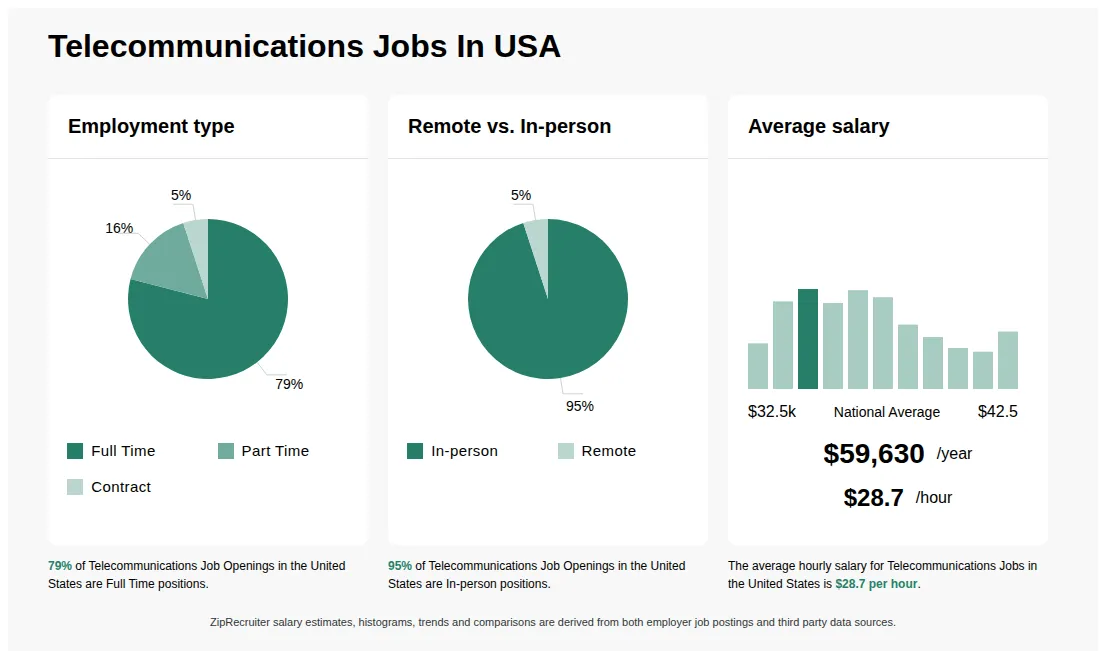
As of Jun 16, 2026, the average hourly pay for telecommunications in the United States is $28.67, according to ZipRecruiter salary data. Most workers in this role earn between $22.12 and $33.65 per hour, depending on experience, location, and employer.

What are the careers in telecommunication?

Careers in telecommunications include roles such as network engineers, telecommunications technicians, systems analysts, and installation specialists. These jobs often require knowledge of networking protocols, hardware, and software, as well as certifications like Cisco or CompTIA. Opportunities exist in service providers, equipment manufacturing, and corporate IT departments.

What Are Telecommunications Jobs?

Telecommunications jobs involve developing, installing, and using technology to send messages over long distances, such as through cable, satellite, radio, mobile phones, video, and the internet. There are a wide variety of jobs within this industry, such as with networks that provide communication transmission signals and the manufacturers of the equipment that produces the signals. In broadcast and online media, you can work in sales, administration, or customer service working over the phone, and in technical jobs to work as a mechanic or technician repairing equipment and developing new technology. You can also work in a corporate setting or at radio and television stations.


What jobs pay $2000 a day?

In telecommunications, high-paying roles such as senior network architects, telecommunications directors, or specialized consultants can earn around $2,000 per day, especially with extensive experience, certifications, and in high-demand environments. These positions often require advanced technical skills, leadership abilities, and sometimes security clearances or industry certifications like Cisco CCIE or PMP.

What do you do in a telecommunications job?

A telecommunications job involves installing, maintaining, and repairing communication systems such as phone lines, internet networks, and wireless devices. It requires technical skills, knowledge of networking equipment, and often certifications like Cisco or CompTIA. Workers may troubleshoot issues, upgrade systems, and ensure reliable communication services in various environments.

What job makes $10,000 a month without a degree?

In telecommunications, roles such as experienced sales managers, network consultants, or freelance technicians can potentially earn $10,000 or more monthly without a formal degree, especially with extensive experience, certifications, and a strong client base. High earnings often depend on skills, reputation, and the ability to secure large contracts or commissions.

What is the difference between Telecommunications vs Network Technician?

AspectTelecommunicationsNetwork Technician
Required CertificationsFCC licenses, Cisco certificationsCompTIA Network+, Cisco CCNA
Work EnvironmentTelecom companies, field sites, officesData centers, offices, client sites
Industry UsageTelecom service providers, infrastructureIT companies, network support
Job FocusInstalling, maintaining telecom systemsConfiguring, troubleshooting networks

Telecommunications professionals focus on installing and maintaining telecom infrastructure, while Network Technicians primarily troubleshoot and support computer networks. Both roles require certifications like Cisco or CompTIA and often work in similar environments, but their technical focus differs, with telecommunications centered on voice and data transmission systems and network technicians on data network support.

What are some common challenges faced by professionals in the telecommunications industry and how can new hires prepare for them?

Professionals in telecommunications often deal with rapid technological advancements and the need to adapt quickly to new systems and protocols. Meeting customer expectations for reliable service while managing network upgrades or troubleshooting outages can be demanding. New hires can prepare by staying updated on industry trends, developing strong problem-solving skills, and being open to ongoing learning and collaboration with cross-functional teams such as engineers and customer support. Familiarity with regulatory standards and best practices in network security is also valuable.

What are telecommunications jobs?

Telecommunications jobs involve the installation, maintenance, and repair of systems that transmit data, voice, and video across distances. Professionals in this field work with technologies such as phone lines, fiber optics, satellites, and wireless networks. Roles can range from network engineers and technicians to sales and customer support specialists, all focused on ensuring reliable communication services. The sector is essential for connecting people and businesses globally and is rapidly evolving with advancements like 5G and fiber-optic technology.

What are the key skills and qualifications needed to thrive in Telecommunications, and why are they important?

To thrive in Telecommunications, you need a solid understanding of networking, signal processing, and communications technology, often backed by a degree in electrical engineering or a related field. Familiarity with industry-standard tools and certifications such as Cisco (CCNA/CCNP), fiber optics systems, and network management platforms is essential. Strong problem-solving, teamwork, and effective communication skills are vital for troubleshooting and collaborating across departments. These skills ensure reliable network performance, rapid issue resolution, and successful adaptation to evolving technologies in the telecom sector.
What cities are hiring for Telecommunications jobs? Cities with the most Telecommunications job openings:
What are the most commonly searched types of Telecommunications jobs? The most popular types of Telecommunications jobs are:
What states have the most Telecommunications jobs? States with the most job openings for Telecommunications jobs include:
Infographic showing various Telecommunications job openings in the United States as of June 2026, with employment types broken down into 70% Full Time, 5% Part Time, 5% Temporary, 15% Contract, and 5% Nights. Highlights an 95% In-person, and 5% Remote job distribution, with an average salary of $59,630 per year, or $28.7 per hour.

Telecommunications Specialist

Yurok Telecommunications Corporation

Eureka, CA • On-site

$29.75 - $49.10/hr

Full-time

Posted 26 days ago


Job description

JOB TITLE:Certified Telecommunications Specialist JOB GRADE: 10-11REPORTS TO: Operations ManagerFLSA:Non-Exempt LOCATION: Yurok ReservationDEPARTMENT: YTELDIVISION: Operations ALL HIRING IS SUBJECT TO THE YUROK TRIBE’S HIRING PREFERENCE SALARY RANGE:                                                                    $29.75 - $49.10** position based out of Klamath with travel around reservation as needed**
POSITION SUMMARY:

Under the general supervision of the Operations Manager, incumbent is responsible for installation, daily operation, maintenance, and problem resolution for a telecommunications network; maintains relevant certifications required, provides support to the Yurok Connect Program.
DUTIES AND RESPONSIBILITIES:
  1. Climbing telecommunication towers.
  2. Activities necessary to maintain status as a certified climber.
  3. Troubleshooting and repairing backup power systems.
  4. Installs, maintains, and repairs wireless Client Premise Equipment (CPE) at customer locations and the Tribe's telecommunications network and equipment.
  5. Maintains and manages the customer database.
EDUCATION/EXPERIENCE:
1. G10-High School or GED plus 1 year specialized experience plus Certified Tower Climber.
       2.  G11-High School plus 3 year specialized experience plus Certified Tower Climber,
       4.    G12-High School plus 5 year specialized experience plus Certified Tower Climber
 

visit YurokTelecom.com to learn more about our team. Wok'hlew

Powered by JazzHR

9r7ARxuazt