1

Systems Administrator Jobs (NOW HIRING)

Be Seen First

Systems Administrator

Nashville, TN · On-site

$70K - $100K/yr

The system administrator must have a deep and broad knowledge of computer software, hardware, and networks. S/He will be responsible for designing, organizing, modifying, and supporting our company ...

Systems Administrator Salary Range: $80,000 - $110,000 Position Overview We are seeking an experienced Systems Administrator to provide advanced support for enterprise IT systems that enable safety ...

Systems Administrator San Francisco, CA (near Civic Center) | Full-Time | $95K-$110K Join a respected San Francisco institution at the intersection of innovation, education, and the performing arts ...

Morfologica, Inc. is seeking several Systems Administrators to work at various Federal Facilities throughout Northern Virginia. Multiple positions are available at different sites. ONLY CANDIDATES ...

The System Administrator maintains, upgrade and manages all software, hardware and networks. System Administrator ensures the technology infrastructure runs smoothly and efficiently. Essential Duties ...

next page

Showing results 1-20

Systems Administrator information

See salary details

$41K

$88.9K

$137.5K

How much do systems administrator jobs pay per year?

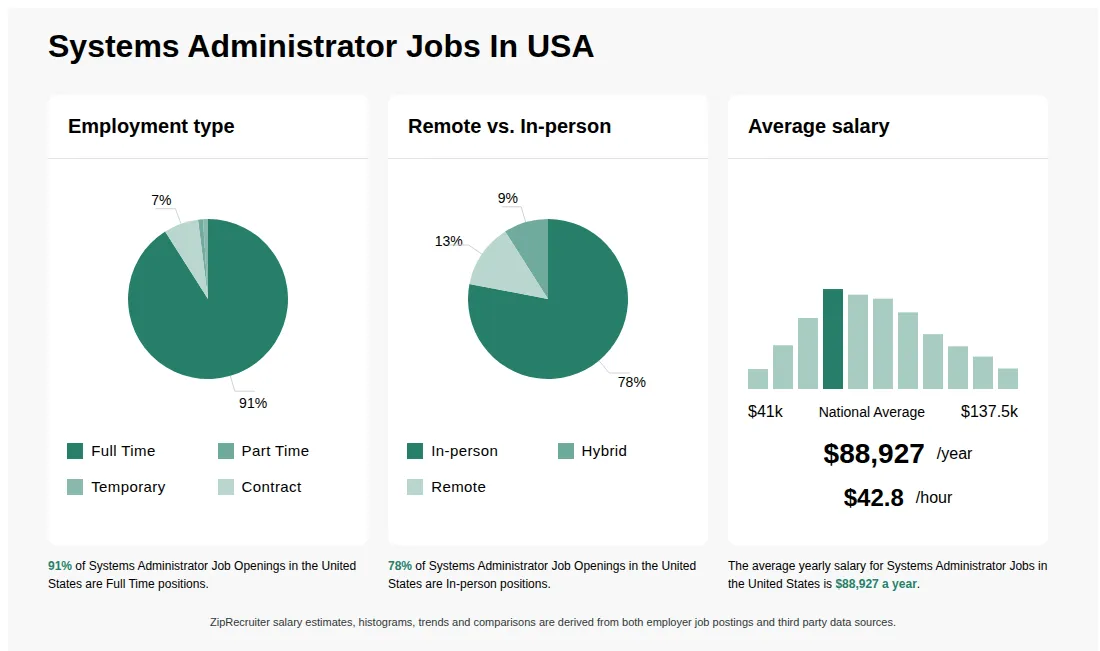
As of Jun 24, 2026, the average yearly pay for systems administrator in the United States is $88,927.00, according to ZipRecruiter salary data. Most workers in this role earn between $70,000.00 and $104,000.00 per year, depending on experience, location, and employer.

What does a Systems Administrator do?

A Systems Administrator manages and maintains an organization’s computer systems, servers, and networks to ensure they run efficiently and securely. They install, configure, troubleshoot hardware and software, monitor system performance, and implement security measures, often using tools like monitoring software and scripting. Strong technical skills, certifications such as CompTIA Server+ or Microsoft Certified: Windows Server, and the ability to respond quickly to technical issues are essential in this role.

Will AI replace sys admins?

Systems administrators perform tasks such as managing networks, servers, and security, which require technical expertise and problem-solving skills. While AI can automate routine tasks and assist in monitoring and troubleshooting, it is unlikely to fully replace sys admins, as human oversight and complex decision-making remain essential in IT environments.

Can you be a sysadmin without a degree?

Systems administrators can often enter the field without a degree by gaining relevant skills through certifications, self-study, and hands-on experience with operating systems, networking, and scripting. Employers may prioritize practical knowledge and technical abilities over formal education, though some roles may prefer or require a degree or equivalent experience.

What Is the Job Description of a Systems Administrator?

The primary duties of a system administrator are to install, update, and maintain computer systems while managing user access regimes. As a systems administrator, you have administrative privileges to change settings, install or remove software, and access security functions unavailable to normal users. A systems administrator might oversee multiple machines at once, or even an entire network. You provide technical support to users who are experiencing problems and collaborate with network administrators to ensure the continued performance of the network. As a systems administrator, you determine the level of access a user has to network information and what operations they can perform, limiting users to only what they need to perform their job.

What are some typical challenges a Systems Administrator faces when managing both on-premises and cloud infrastructure?

Systems Administrators often juggle responsibilities across on-premises servers and cloud-based platforms, which can introduce challenges such as ensuring seamless integration, maintaining consistent security policies, and managing access controls. Balancing updates, backups, and monitoring tools across different environments requires strong organizational skills and up-to-date technical knowledge. Effective communication with other IT team members and end users is also crucial for troubleshooting and minimizing downtime.

What are Systems Administrators?

Systems Administrators, often called SysAdmins, are IT professionals responsible for managing, maintaining, and supporting computer systems and networks within an organization. Their duties include installing hardware and software, monitoring system performance, troubleshooting technical issues, and ensuring system security and data integrity. They play a key role in minimizing downtime, performing regular backups, and updating systems to keep an organization's IT infrastructure running smoothly.

What are the key skills and qualifications needed to thrive as a Systems Administrator, and why are they important?

To thrive as a Systems Administrator, you need a solid understanding of operating systems, network management, and security protocols, typically supported by a relevant degree or certifications like CompTIA Network+, Microsoft Certified Solutions Associate (MCSA), or Linux+. Familiarity with tools such as Active Directory, virtualization platforms, and configuration management systems is essential. Strong problem-solving abilities, attention to detail, and effective communication skills help you respond quickly to issues and work collaboratively with IT teams. These skills and qualifications are crucial for maintaining system reliability, minimizing downtime, and ensuring secure, efficient IT operations.

Is system admin a high paying job?

Systems administrators typically earn competitive salaries that vary by experience, location, and industry. In many regions, they are considered well-paid IT professionals, especially those with certifications like CompTIA or Cisco and skills in network management and security.

What is the difference between Systems Administrator vs Network Administrator?

AspectSystems AdministratorNetwork Administrator
CertificationsCompTIA Server+, Microsoft Certified: Windows Server FundamentalsCompTIA Network+, Cisco CCNA
Work EnvironmentManage servers, operating systems, and enterprise applicationsFocus on network infrastructure, routers, switches, and connectivity
Employer & Industry UsageIT departments across various industries, supporting internal systemsOrganizations with complex networks, telecom, and internet service providers

While both roles support IT infrastructure, Systems Administrators primarily manage servers and software systems, whereas Network Administrators focus on network hardware and connectivity. Understanding these differences helps in choosing the right career path or job focus within IT.

What cities are hiring for Systems Administrator jobs? Cities with the most Systems Administrator job openings:
What are the most commonly searched types of Systems Administrator jobs? The most popular types of Systems Administrator jobs are:
Who are the top companies hiring for Systems Administrator jobs? The top employers for Systems Administrator jobs are:
What states have the most Systems Administrator jobs? States with the most job openings for Systems Administrator jobs include:
Infographic showing various Systems Administrator job openings in the United States as of June 2026, with employment types broken down into 96% Full Time, and 4% Part Time. Highlights an 100% In-person job distribution, with an average salary of $88,927 per year, or $42.8 per hour.
Systems Administrator

Systems Administrator

Southern Benefit Administrators - IT

Nashville, TN • On-site

$70K - $100K/yr

Full-time

Medical, Dental, Vision, Life, PTO

Posted 4 days ago

Be Seen First

After you apply to this job, you can share why you’re interested to jump to the top of the candidate list.


Job description

We are currently seeing an experienced system administrator to join our team. The system administrator must have a deep and broad knowledge of computer software, hardware, and networks. S/He will be responsible for designing, organizing, modifying, and supporting our company’s computer systems. The System Administrator will design and oversee local area networks, wide area networks, and network segments. Daily tasks may include installing, upgrading and monitoring software and hardware. The System Administrator will maintain the essentials such as operating systems, business applications, security tools, web-servers, email, laptop, and desktop PCs.

System Administrator Duties and Responsibilities

  • Support LANs, WANs, network segments, Internet, and intranet systems
  • Ensure the design of the system allows all components to work properly together
  • Make recommendations for future upgrades
  • Maintain network and system security
  • Troubleshoot problems reported by users and analyze and isolate issues
  • Monitor networks to ensure security
  • Evaluate and modify the system’s performance
  • Maintain network facilities in individual machines, such as drivers and settings of personal computers as well as printers
  • Maintain the integrity of the network, server deployment, and security
  • Ensure network connectivity throughout a company’s LAN/WAN infrastructure is on par with technical considerations
  • Design and deploy networks; Maintain network servers such as file servers, and VPN gateways
  • Perform network address assignment
  • Assign routing protocols and routing table configuration
  • Assign configuration of authentication and authorization of directory services
  • Administer servers, laptop and desktop computers, printers, routers, switches, firewalls, phones, company mobile phones, smartphones, software deployment, security updates and patches

System Administrator Requirements and Qualifications

  • Bachelor degree in Computer Sciences, Technology, degree or relevant experience
  • Specific experience with Microsoft Operating Systems, 10/11
  • Windows Server 2012-2019
  • Specific experience with Barracuda Backup
  • Experience with Fortigate firewall technology
  • Experience with Windows Defender
  • Microsoft Azure, Entra and InTune
  • SFTP, Experience with JSCAPE is a plus.
  • Experience with Mimecast is a plus
  • Experience with iSCSI SANS; Dell EQ and NetApp knowledge is a plus